

If you’ve ever tried transferring an ad account to another Business Manager, you already know the process looks simple on the surface, but feels dangerously unclear once you’re responsible for real ad spend, real clients, and real risk.
Facebook’s documentation makes it sound like a few clicks.
In reality, this action sits at the intersection of Business Manager trust, asset ownership, and long-term account stability.
This article isn’t a generic how-to.
It’s a behind-the-scenes perspective, based on what actually happens when ad accounts are moved between Business Managers, especially in agency, scaling, or multi-BM environments.
Why Transferring an Ad Account Is Never “Just a Technical Action”
On paper, transferring an ad account means changing its owning Business Manager.
In Facebook’s system, it means something else entirely:
You are re-assigning trust.
Every ad account carries historical data:
- Spending patterns
- Policy interactions
- Payment behavior
- Asset associations
- Risk signals from connected profiles and BMs
When you move an ad account, Facebook doesn’t reset that history.
It re-evaluates it inside a new trust container.
That’s where most problems begin.
A Real Scenario: The Transfer That Triggered a Silent Review
I once worked with a team scaling international campaigns.
Strong creatives, stable ROAS, no policy violations.
They transferred a high-spend ad account from an old Business Manager into a new “clean” BM-expecting better structure.
No error. No warning.
Ads kept running for 48 hours.
Then:
- Spending slowed
- Learning phase reset
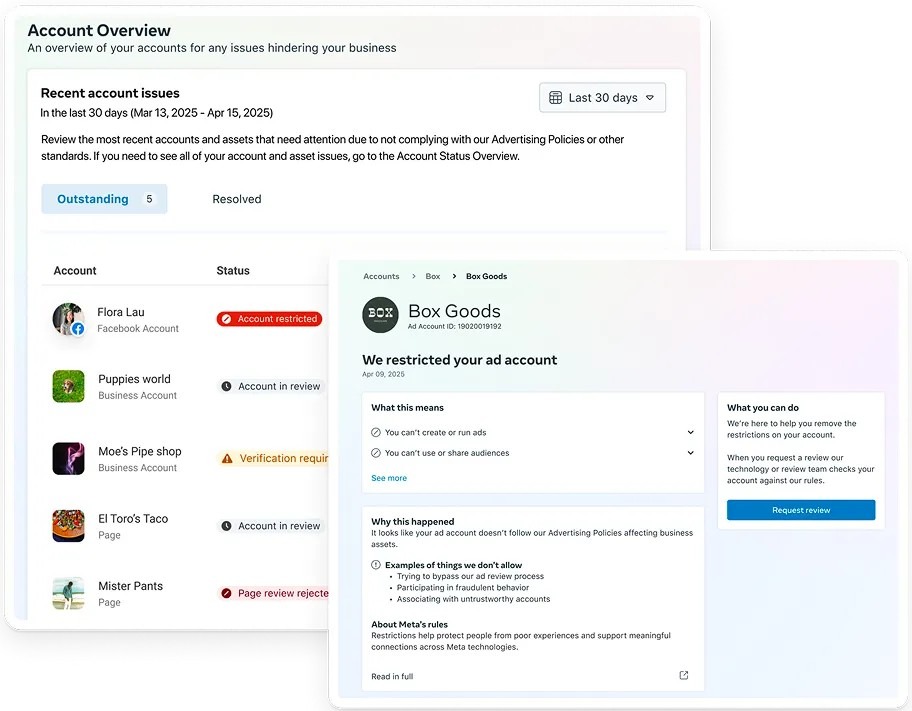
- Finally: “Ad Account Restricted from Advertising”
No rejected ads.
No appeal explanation.
What happened wasn’t a policy issue.
It was a Business Manager trust mismatch.
What Facebook Actually Evaluates During an Ad Account Transfer
When transferring an ad account to another Business Manager, Facebook silently checks several behind-the-scenes factors.
1. Trust Compatibility Between Business Managers
Facebook compares:
- Age of the new Business Manager
- Historical violations or restrictions
- Asset density (pages, ad accounts, pixels)
- Admin profile trust scores
If the receiving BM has lower trust than the previous one, the ad account inherits risk instantly.
2. Admin & Ownership Structure Changes
Sudden shifts in:
- Primary owner
- Financial editor
- Ad account admin roles
are treated as control volatility.
From Facebook’s perspective, rapid control changes = higher abuse potential.
3. Payment Method Continuity
Even if you keep the same card:
- Changing billing responsibility
- Resetting payment thresholds
- Switching funding sources post-transfer
can flag the account for financial review.
Billing stability is a core risk signal, not a side detail.
4. Asset Graph Re-Association
After transfer, the ad account is re-linked to:
- New pages
- New domains
- New pixels
- New Business Manager graph
If any of those assets have prior risk, the transferred account becomes collateral damage.
Common Expert Mistakes During Ad Account Transfers
Even experienced advertisers make these mistakes:
- Transferring into a freshly created Business Manager
- Moving multiple ad accounts at once
- Changing admins and payment methods immediately after transfer
- Using the transfer as a “clean slate” strategy
- Transferring while campaigns are aggressively scaling
None of these are policy violations.
All of them increase structural risk.
Best Practices for Safe Ad Account Transfer (Expert Level)

If transferring an ad account is unavoidable, experienced teams follow a controlled approach.
Pre-Transfer Checklist
- Receiving Business Manager is aged and stable
- Minimal recent asset changes
- Trusted admin profiles only
- Stable payment method already added
Transfer Execution
- Transfer one ad account at a time
- Avoid simultaneous permission or billing changes
- Maintain identical campaign structure initially
Post-Transfer Stabilization
- Let campaigns run without scaling for several days
- Monitor delivery volatility, not just approval status
- Delay any structural changes until stability is confirmed
This isn’t about speed.
It’s about signal consistency.
Can You Transfer an Ad Account Without Risk?
No transfer is risk-free.
But risk can be:
- Anticipated
- Minimized
- Contained
The biggest misconception is believing that transferring an ad account “fixes” past issues.
Facebook doesn’t forget.
It reassesses.
Final Thoughts
Transferring an ad account to another Business Manager is not a routine admin task, it’s a trust event.
For solo advertisers, the impact may be small.
For agencies, media buyers, and high-budget operations, it can determine whether an account scales smoothly or enters a silent review loop.
Behind every successful transfer is not a trick, but discipline:
- Stable Business Manager setup
- Predictable control
- Respect for Facebook’s risk models
Those who understand this don’t fear transfers.
They plan them.
Để lại một bình luận