
A disabled Facebook ad account is one of the most disruptive events for advertisers, agencies, and performance marketers. According to Meta’s own transparency disclosures, millions of ad accounts are restricted or disabled every year due to policy violations, automated risk signals, or abnormal activity patterns. In response, many advertisers instinctively create a new Facebook Ads account, assuming it is the fastest way to resume campaigns. In reality, this approach frequently escalates the problem, leading to broader asset bans, Business Manager restrictions, and even permanent advertising ineligibility.
From a Facebook Ads policy and system-design perspective, creating a new ad account after a disablement is often interpreted as circumvention behavior. Meta’s enforcement algorithms do not evaluate ad accounts in isolation; instead, they assess an interconnected ecosystem that includes user profiles, Business Managers, payment methods, domains, pixels, IP addresses, devices, and historical behavior patterns. When a disabled advertiser attempts to restart by opening a new ad account without resolving the root cause, the system can quickly associate the new entity with the previously penalized one, triggering faster and harsher enforcement.
One critical reason this happens is Facebook’s reliance on entity-level risk scoring. Internal enforcement models assign trust scores not only to ad accounts but also to Business Managers and individuals. If an advertiser with a disabled Facebook ad account creates a new one using the same Business Manager, payment method, or even the same IP environment, the new account often inherits the negative trust signals. In many cases, advertisers report that new accounts are disabled within hours or days, sometimes before any ads are approved. This is consistent with Meta’s stated policy that prohibits “repeated attempts to circumvent enforcement systems,” a violation that can result in permanent advertising bans.
Another overlooked factor is the escalation from account-level enforcement to Business Manager-level enforcement. While a single disabled ad account can often be appealed and reinstated, repeated violations or evasive behavior may lead to a restricted Business Manager. Once a Business Manager is restricted, all associated ad accounts, pixels, catalogs, and even Instagram profiles can be affected. Industry case studies from agencies managing hundreds of Facebook ad accounts show that Business Manager restrictions can reduce recovery rates by more than 70% compared to isolated ad account disables, making long-term advertising recovery significantly more difficult.
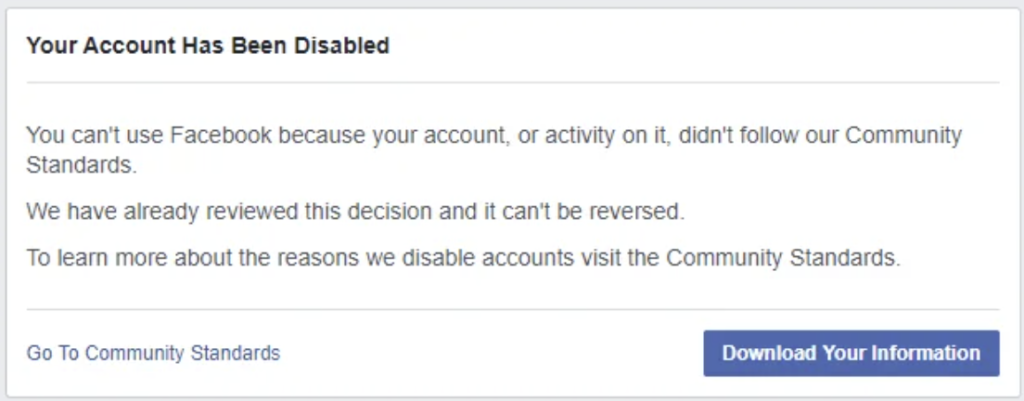
Additionally, creating a new Facebook Ads account does not address the underlying policy issue that caused the original disablement. Common triggers include misleading claims, non-compliant landing pages, prohibited financial or health-related offers, aggressive lead generation tactics, or inconsistent business verification data. Without a comprehensive policy audit and corrective actions, the same violations are likely to recur. Meta’s automated review systems are designed to detect repeated patterns, meaning advertisers who repeat the same mistakes face progressively shorter enforcement cycles and lower chances of successful appeal.
From a compliance and recovery standpoint, the more effective approach is to stabilize and rehabilitate the existing advertising infrastructure. This includes conducting a full Facebook Ads policy compliance audit, aligning ad creatives and landing pages with Meta’s Advertising Policies, verifying business information, and submitting a structured appeal through the appropriate support channels. Advertisers with verified Business Managers and a clean compliance history are statistically more likely to regain access than those who abandon disabled accounts and attempt to start over.
For experienced advertisers and agencies, the strategic takeaway is clear: a disabled Facebook ad account is a governance and risk-management issue, not merely a technical inconvenience. Creating a new ad account without resolving trust, compliance, and identity signals often amplifies enforcement rather than bypassing it. In the Facebook Ads ecosystem, longevity, transparency, and policy alignment are far more valuable than short-term workarounds. By treating account disablements as an opportunity to improve structural compliance rather than evade enforcement, advertisers significantly increase their chances of sustainable, long-term advertising success on Meta’s platforms.
Leave a Reply